The practical part
The essentials
Sheltered bays: the east coast
El Castillo beach in Caleta de Fuste is the one Visit Fuerteventura calls very safe, with soft blond sand and water it describes as calm all year because it sits in a bay; that describes the bay, not the sea on your day, and its own sheet still asks you to bathe with caution. Lines 3, 10 and 16 have a Caleta de Fuste stop. La Lajita's beach, 915 metres of black sand with shiny blue stones, is listed as calm and clean with few bathers, on line 1 at La Lajita Pueblo and line 10 at Zoo; it has no lifeguard. Gran Tarajal's long dark-sand town beach carries a Blue Flag and has a promenade, on lines 1, 10 and 16.
Checked Visit Fuerteventura: The best beaches of FuerteventuraVisit Fuerteventura: Caleta de Fuste tourist resort TIADHE lines 3, 10, 16, 1
Long white beaches: Jandía
Costa Calma's beach runs two kilometres and is sheltered from the wind by the hotels behind it, with Parada Preferente Costa Calma on line 10 and the petrol-station stop on lines 1 and 5. Playa del Matorral at Morro Jable is four kilometres along an avenue of shops and restaurants beside the Saladar de Jandía, a protected salt marsh. Esquinzo-Butihondo is almost three kilometres in sections with sunbeds, showers and bars, and nudism is common; lines 1 and 5 stop at Esquinzo. Mal Nombre is a quiet white-sand beach sheltered by cliffs, unsupervised, with the stop Tierra Dorada on lines 1 and 5 on the coast road.
Checked Visit Fuerteventura: The best beaches of Fuerteventura TIADHE lines 10, 1, 5
The north: dunes, surf and coves
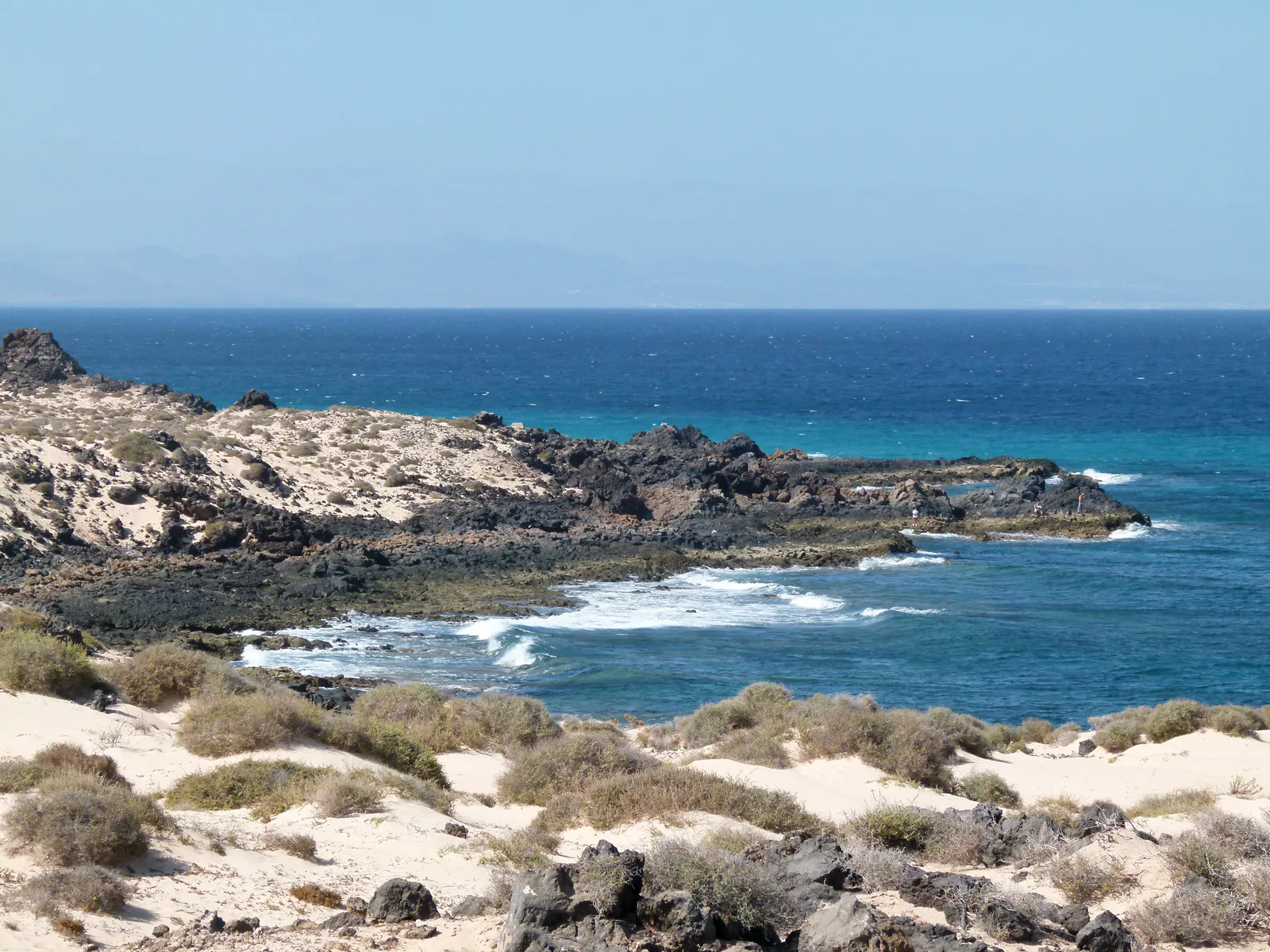
The Grandes Playas of Corralejo run nine kilometres beside the largest dunes in the Canary Islands; El Médano, nearest the town, is a kitesurfing and windsurfing beach and Bajo Negro by the Riu hotels has sunbeds. Line 6's maps have the stops Hoteles Riu Ida and Hoteles Riu. El Cotillo's northern coves, La Concha among them, are white sand and calm turquoise water close to the village, which lines 7 and 8 serve; expect to walk from the village stops.
Checked Visit Fuerteventura: The best beaches of FuerteventuraVisit Fuerteventura: Surfing in El Cotillo TIADHE lines 6, 7, 8
The ones to watch, not swim: Cofete and the west
Visit Fuerteventura describes Cofete's twelve kilometres as wild, with a rough ocean and no paved road, and El Cotillo's exposed shore as the surf side. Line 111 reaches Cofete from Morro Jable every day with no seat reservation; treat the beach as a walk with the sea at a respectful distance. Sotavento's famous lagoon, nine kilometres of five beaches, has no usable bus stop: its Hotel Gorriones stop is suspended on TIADHE's maps, so it is a taxi, a hotel shuttle or a long walk from Costa Calma.
Checked Visit Fuerteventura: Cofete beach visitor guidanceVisit Fuerteventura: Sotavento beachVisit Fuerteventura: Surfing in El Cotillo TIADHE lines 111, 1
Flags, lifeguards and what this site does not know
Visit Fuerteventura marks La Lajita and Mal Nombre as unsupervised and asks visitors to bathe with caution at El Castillo; it does not publish a lifeguard season per beach. The flag meanings are the Canary health service's: green, bathing permitted; yellow, caution; red, bathing prohibited; other flags vary by beach, so read the sign at the entrance. The flag flying on the day is the lifeguards' word and this site repeats none of it; 1-1-2 Canarias says never bathe under a red flag or where nobody is on watch, and treat a beach the board marks as unsupervised as exactly that. Blue Flag status is the one Visit Fuerteventura names for Gran Tarajal; the ADEAC list for 2026 was not reachable by this site's checks, so other Blue Flags are not claimed here.
Checked Visit Fuerteventura: The best beaches of FuerteventuraVisit Fuerteventura: Gran Tarajal beach Gobierno de Canarias, Servicio Canario de la Salud: Servicio Canario de la Salud: bathing areas, sea state and the meaning of the flags Gobierno de Canarias, 1-1-2 Canarias: 1-1-2 Canarias: self-protection measures to prevent drownings
Wind: the island's weather, and which side to pick
Fuerteventura's beaches are famous for wind, which is why Sotavento's lagoon and Corralejo's El Médano are windsurfing and kitesurfing places. Costa Calma is listed as protected from the wind by its hotels, El Castillo as a sheltered bay, and Mal Nombre as sheltered by cliffs. On a windy day those are the bus-reachable choices; the open west coast is for walking.
Checked Visit Fuerteventura: Sotavento beachVisit Fuerteventura: The best beaches of Fuerteventura
Nudism, families and shade
Visit Fuerteventura names Esquinzo-Butihondo as suited to nudism in privacy and lists a nudist area at Mal Nombre. For families it describes El Castillo as very safe and calm all year, and Costa Calma and Matorral as resort beaches with services behind them. Natural shade is rare everywhere; the dunes and Cofete have none.
Checked Visit Fuerteventura: The best beaches of Fuerteventura
Snorkelling and clear water
Visit Fuerteventura singles out Lobos for its calm, transparent water at La Concha and the natural pools of El Puertito, and El Cotillo's northern lagoons for calm turquoise water; both are boat or walk, not bus-door. La Lajita is listed as clean and calm. The site makes no other snorkelling claims.
Checked Visit Fuerteventura: The best beaches of FuerteventuraVisit Fuerteventura: Islote de Lobos walking route
Beach by beach: stop, walk, conditions, lifeguard
What the tourism board's beach sheets and TIADHE's maps say for each beach with a bus, in that order; where a sheet is silent, the block says so. "Wind" and "calm water" are the sheet's own marks, often together: the water is calm, the air is not.
Checked Visit Fuerteventura: The best beaches of Fuerteventura TIADHE: TIADHE routes
El Castillo, Caleta de Fuste
Stop: Caleta de Fuste on lines 3, 10 and 16, with a bus stop listed on the beach's own sheet. Walk: the sheet names a bus and taxi stop at the beach; the distance from your stop depends on which Caleta stop you choose. Conditions: 600 metres of golden sand in a small bay, calm water all year, yet the sheet also marks wind and strong waves and says bathe with caution. Lifeguard: the sheet marks cover all year. Services: sunbeds, parasols, showers, toilets, restaurants, accessible.
Checked Visit Fuerteventura: El Castillo beach TIADHE lines 3, 10, 16
Grandes Playas, Corralejo
Stop: Hoteles Riu on line 6, beside the beaches. Walk: from the stop onto the sand, across the dunes with no shade. Conditions: nine kilometres of white shell sand beside the dunes, calm water and wind marked together; El Médano nearest the town is for kitesurfing and windsurfing, the southern coves are nudist. Lifeguard: the sheet marks cover all year and names lifeguards at Burro beach; sunbeds and parasols at Bajo Negro by the Riu hotels. Accessible, with a restaurant.
Checked Visit Fuerteventura: Corralejo beach TIADHE: TIADHE line 6
Costa Calma
Stop: Parada Preferente Costa Calma on line 10; the petrol-station stop on lines 1 and 5. Walk: through the resort to the shore; Visit Fuerteventura gives no distance. Conditions: two kilometres of white sand and turquoise water, sheltered from the wind by the hotels behind it, by Visit Fuerteventura's beaches page. Lifeguard: the beaches page does not say. Services: the resort's.
Checked Visit Fuerteventura: The best beaches of Fuerteventura TIADHE lines 10, 1, 5
Sotavento (La Barca, Risco del Paso, Mirador, Los Canarios, Malnombre)
Stop: none usable at present; the Hotel Gorriones stop on the line 1 and 5 maps is suspended. Walk: from Costa Calma along the shore at low tide, or to Malnombre from Tierra Dorada. Conditions: nine kilometres of white sand, calm water and wind marked together, a three-kilometre lagoon behind a sand bar for beginners' windsurfing and kitesurfing, nudist zone. Lifeguard: the sheet marks cover all year. Services: sunbeds, showers, restaurant, sports equipment, parking, accessible.
Checked Visit Fuerteventura: Sotavento beach TIADHE lines 1, 5
Mal Nombre
Stop: Tierra Dorada on lines 1 and 5, on the coast road above the beach. Walk: down from the road and back up; Visit Fuerteventura gives no distance. Conditions: 1,500 metres of white sand and turquoise water, calm, sheltered from the wind by cliffs, nudist zone. Lifeguard: none, the sheet marks it unsupervised. Services: a beach bar, showers, toilets, sunbeds, parking.
Checked Visit Fuerteventura: Mal Nombre beach TIADHE lines 1, 5
Esquinzo-Butihondo
Stop: Esquinzo on lines 1 and 5; every line 5 trip enters the development. Walk: through the development to the sand; Visit Fuerteventura calls the beach very accessible. Conditions: almost three kilometres of golden sand in sections, calm water and wind marked together, nudist bathing common. Lifeguard: the sheet marks cover all year. Services: sunbeds and parasols, showers, toilets, beach bars, water-sports hire and classes, tourist information, parking.
Checked Visit Fuerteventura: Butihondo beach TIADHE lines 1, 5
Playa del Matorral, Morro Jable
Stop: Morro Jable on lines 1, 5 and 10; line 10's maps include Faro Morro Jable and CC. Cosmos Jandía along the avenue. Walk: from the avenue straight onto the sand. Conditions: four kilometres of beach beside the Saladar de Jandía salt marsh, a site of scientific interest, by Visit Fuerteventura's beaches page. Lifeguard: the beaches page does not say. Services: the avenue's shops, restaurants and leisure centres.
Checked Visit Fuerteventura: The best beaches of Fuerteventura TIADHE lines 10, 1
Gran Tarajal
Stop: Parada Preferente Gran Tarajal on lines 1, 10 and 16. Walk: into the town and down to the seafront avenue; Visit Fuerteventura gives no distance. Conditions: a kilometre of dark sand along a promenade with a marina, calm water, wind marked, Blue Flag by Visit Fuerteventura's account. Lifeguard: summer only, the sheet says. Services: accessible, parking, restaurant, showers, toilets.
Checked Visit Fuerteventura: Gran Tarajal beach TIADHE lines 1, 10, 16
La Lajita
Stop: La Lajita Pueblo on line 1; Zoo on line 10. Walk: through the village to the bay; Visit Fuerteventura gives no distance. Conditions: 915 metres of black sand under shiny blue stones, 20 metres wide, clean and calm, wind marked, few bathers. Lifeguard: none, the sheet marks it unsupervised. Services: parking, restaurant, showers, toilets.
Checked Visit Fuerteventura: La Lajita beach TIADHE lines 1, 10
Cofete
Stop: the end of line 111 from Morro Jable, over the dirt track. Walk: from the village past the one restaurant onto the sand. Conditions: 6,100 metres by the sheet, twelve kilometres by the text, wild sea, wind and strong waves marked, nudist zone, bathe with caution. Lifeguard: none, the sheet marks it unsupervised. Services: parking and nothing else; no shop, no shade.
Checked Visit Fuerteventura: Cofete beach visitor guidance TIADHE: TIADHE timetable sheets, read 12 October 2026 (ledger)
Asked and answered
Questions people ask
Which Fuerteventura beaches can you get to by bus?
El Castillo (Caleta de Fuste), Costa Calma, Playa del Matorral (Morro Jable), Gran Tarajal, La Lajita, Esquinzo-Butihondo and Mal Nombre have a TIADHE stop beside or near them, and the Grandes Playas by the Corralejo dunes have line 6's Hoteles Riu stops. El Cotillo's coves are a walk from the village. Cofete has line 111 from Morro Jable; Sotavento's lagoon and Lobos do not have a usable bus.
Checked TIADHE lines 3, 1, 5, 10, 6, 111 Visit Fuerteventura: The best beaches of Fuerteventura
Which beach is calm enough for children?
None is calm by promise. Visit Fuerteventura describes El Castillo in Caleta de Fuste as a sheltered bay with calm water, which makes it the likeliest choice, and lists La Lajita as calm but unsupervised. Whichever you pick, the flag and the lifeguard decide on the day: red means no bathing, and that includes paddling at the edge, even when the water looks flat. The Gobierno de Canarias asks you to keep children under control at all times, and the Canary health service adds that armbands do not replace an adult.
Checked Visit Fuerteventura: The best beaches of FuerteventuraVisit Fuerteventura: Caleta de Fuste tourist resort Gobierno de Canarias, Servicio Canario de la Salud: Servicio Canario de la Salud: bathing areas, sea state and the meaning of the flags Gobierno de Canarias, Dirección General de Emergencias: Dirección General de Emergencias: advice for activities at sea
Can you swim at Cofete?
No: do not swim at Cofete. Visit Fuerteventura describes its ocean as rough and the beach as wild and unsupervised, and if no flag is flying, that is not a green flag: it only means no one is telling you the sea is safe. The Cabildo's emergency plan says never to bathe on remote or insufficiently known beaches, because there may be local eddies. Go for the walk and the view, keep well back from the surf, and leave on the line 111 return you fixed before you set out.
Checked Visit Fuerteventura: Cofete beach visitor guidance Cabildo de Fuerteventura: Cabildo de Fuerteventura, Island Emergency Plan, Annex VIII: advice to the public TIADHE: TIADHE line 111
Is there a bus to Sotavento beach?
No usable one at present: the Hotel Gorriones stop on TIADHE's line 1 and 5 maps is suspended, so this site does not advertise it. Costa Calma is the nearest bus-served base; from there the lagoon is a taxi, a hotel shuttle or a long walk.
Checked TIADHE lines 1, 5 Visit Fuerteventura: Sotavento beach
The other half of the plan
And the way back.
Fix the bus back before you spread the towel, from the tab for your day, and allow for the walk from the sand to the stop: at Mal Nombre and the Grandes Playas that walk is on the coast road or through sand. On a west-coast day, leave early enough that a late bus does not become a night on the beach.
Checked TIADHE lines 1, 6 TIADHE: TIADHE timetable sheets, read 12 October 2026 (ledger)